
Take SWE measurements over snow depth data when possible.
September 22, 2026
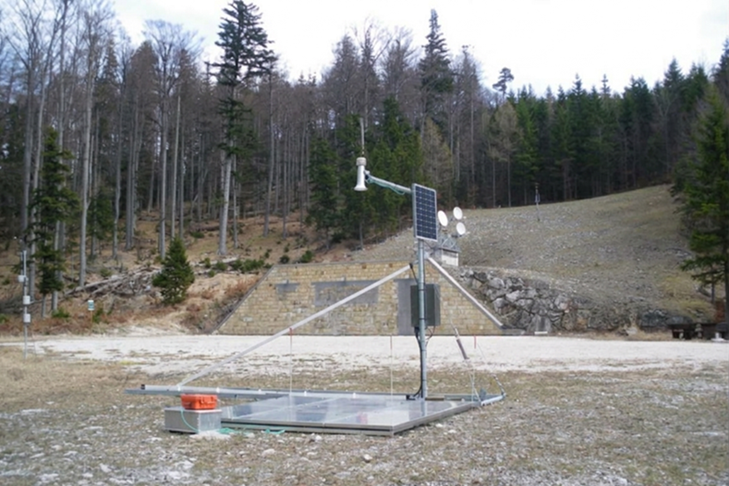
In the western United States, snowpack efficiently stores water during cold months. It serves as the region’s largest reservoir until temperatures warm, when the frozen asset liquidates into water used by communities, hydropower generators, and agricultural producers.
To collect snow data, federal and state operated snowpack telemetry (SNOTEL) stations are equipped with non-contact ultrasonic snow depth sensors. However, snow depth and snow water equivalent (SWE) don’t have a one-to-one ratio. SWE, or the amount of water in a snow sample, can change.
“For example, a snow depth of 30 inches may might have a SWE of 5 inches in Colorado or about 10 inches in Oregon,” explains meteorologist Dr. Zach Butler, Ph.D. via OpenSnow.com.
Automated snow scales
Scientific instruments known as snow scales ease the collection of snow water equivalent measurements. In contrast to the elevated 7 in x 13 snow depth sensor, the no antifreeze / fluidless snow pillow rests on the ground, covering 9 ft x 8 ft and working as a load cell to measure the weight of the snowpack on the panels.
The snow scale provides the snow density value. When paired with a snow depth sensor, the datasets provide SWE observations. SWE monitoring equipment is often co-located with SNOTEL sites, but found at fewer stations as they require more space and carefully chosen to avoid public disturbance and vandalism.
Manual snow surveying and SWE calculations
An alternative to using the automated device is measuring snow depth and extracting snow cores, or snow sampling tubes, and timing their complete melt. Then weigh the core to determine its mass, from which SWE can be derived. Snow water equivalent is the volume of water divided by the sampled area.
Whichever method you choose, take SWE measurements over snow depth data alone when given the option.
Federal and state agencies as well as utilities depend on the ground-based SWE observations to predict the rate of snowmelt and runoff into streams, rivers and reservoirs. Any lapse in data can negatively affect forecasting abilities for water supply, flood risk management, waterpower generation, or water storage.