
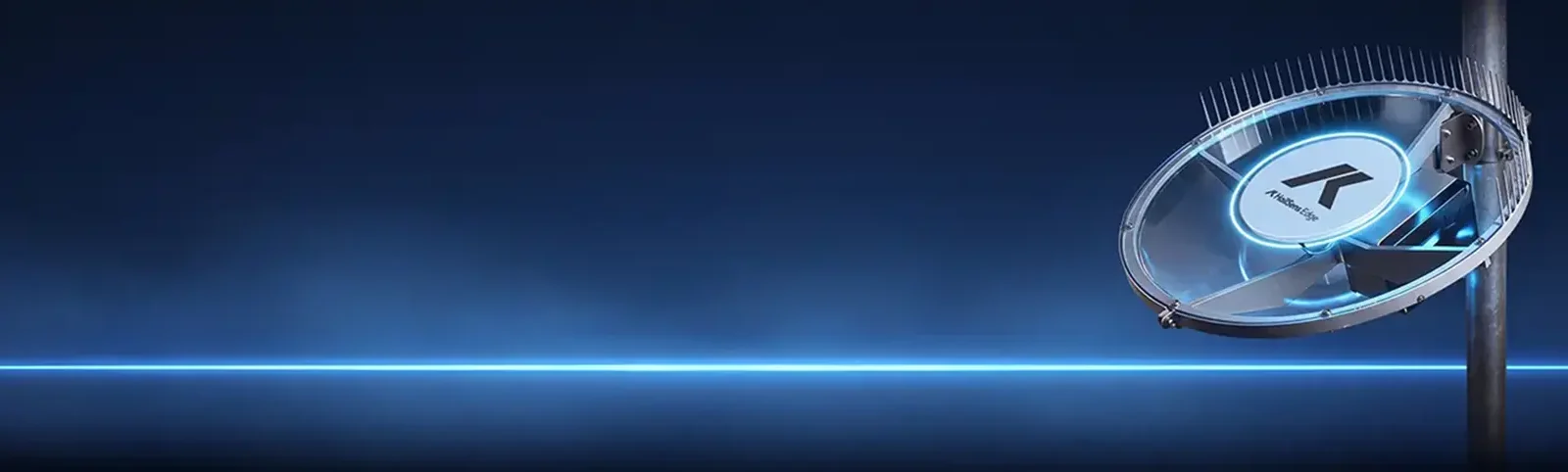
Get the Edge on Hail - A real-time hail monitoring station.
Deliver detailed hail data to SCADA via Modbus. Triage inspections. Expedite claims. Ground-truth radar data.
Hail hits hard. Don’t play with estimates.
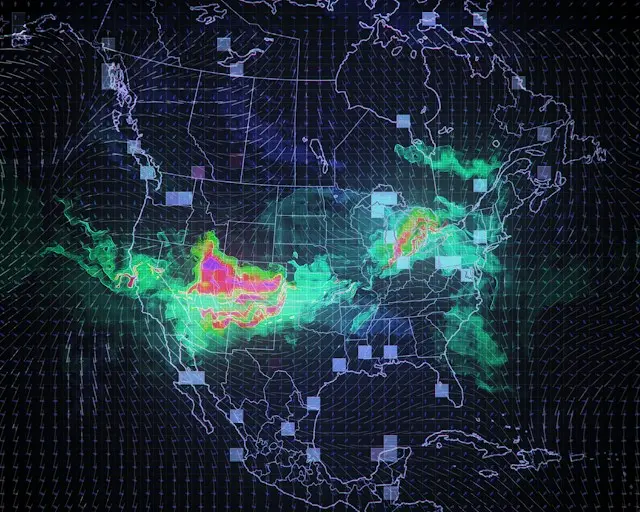
Hail is among the most costly and damaging risks to solar projects. Radar forecasts the likelihood of hail – but it doesn’t record if actually falls. It cannot tell you what actually hit, how hard, or when. After the storm, operational decisions need insight.
Measure what matters to property. Hailstone size and kinetic energy are a more direct proxy for structural damage than frequency of hail days.
source: FM, Mapping the Growing Threat of Hail
Measure every hailstorm. In real time.
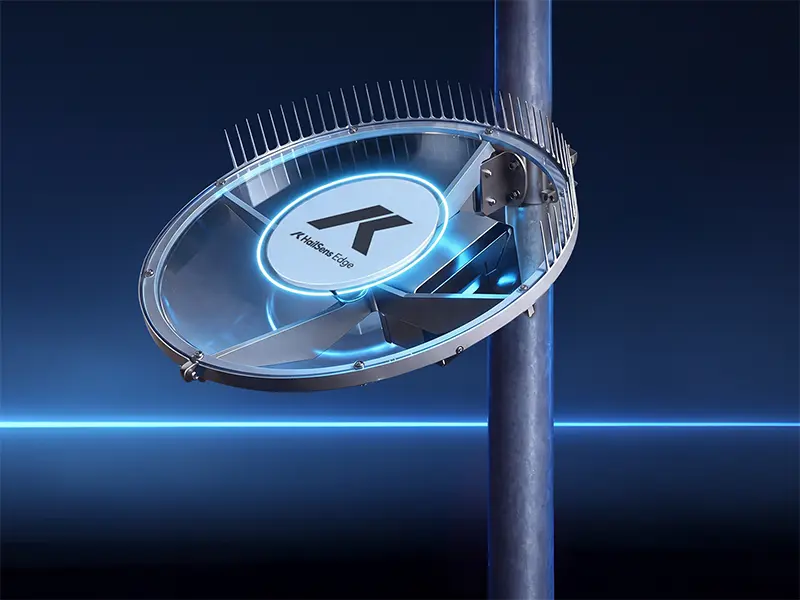
HailSens Edge measures the kinetic energy of each hailstone that strikes the plate, derives its diameter, and records a precise timestamp. With 60+ years of weather, water and environmental monitoring expertise, KISTERS delivers data with ±10% accuracy via this instrument with lifetime calibration. Your operations team works from facts, not estimates.
Accomplish measurement, edge processing, secure communication and redundant data storage in one unit, powered by KIPTEC, KISTERS’ Intelligent Platform for Embedded Connectivity.
Download Expert Q&ACore capabilities.
Use case
Solar assets & operations.
Live hail data supports operational decisions, rapid condition assessments, and documented insurance claims. Know when hail strikes, where it fell, how large and how hard the impact was.
Download the guideUse case
Insurers and reinsurers.
Evidence-based views of solar project resilience enable insurers to rightsize policies. Proactive solar asset owners who optimize natural catastrophe risk can be rewarded with accurate rates, terms and deductibles… or shop for more coverage.
Use case
Weather services and researchers.
Secure connectivity compatible with the World Meteorological Organization (WMO) First-Mile Data Collection (TT-1M) standard delivers statistically sound hail datasets for forecasting and research. The heartbeat and large 2.15 ft² (0.2 m²) sensing area record hail distribution.



KIPTEC inside, confidence outside.
Accomplish measurement, edge processing, secure communication and redundant data storage in one unit, powered by KIPTEC, KISTERS’ Intelligent Platform for Embedded Connectivity.
Learn how KIPTEC works
HailSens represents the culmination of years of dedicated research. It delivers continuity and accuracy in hail impact data collection. Proven in the field, HailSens provides unparalleled real-time insights, making it the first choice for both insurance claims and scientific research.
Edgar Wetzel, Global Head of Product Management – HydroMet Instrumentation, KISTERS
60+
years of experience
120+
countries
7000+
monitoring sites
Enhancements.

KISTERS datasphere.
See hail data in context — on maps, dashboards, graphs — compare sites, set alarms/alerts for your team in any browser. Secure login. No coding needed.

HailSens360.
Add KISTERS high-resolution hail forecasts and nowcasts to real-time hail observations. Get alerts and act before impact to mitigate risk of hail damage. Available in U.S. and Europe.
HailSens Now.
Act on early warnings from hail nowcasts with 9x the spatial resolution and 10x the temporal resolution of publicly available models.
FAQs.
What does HailSens Edge measure?
The HailSens Edge hail monitoring station precisely quantifies and validates hail impacts in real-time and for comprehensive hail storm event analysis.
It measures kinetic energy from 0.01 to 28 J to determine hailstone diameter from 0.20 in to 1.97 in (5 mm to 50 mm), with ±10% accuracy (based on the specific mass density of ice and a spherical model).
Which communication options are available?
HailSens Edge supports Modbus and Ethernet for industrial operations.Mobile use is supported by LTE-M with WMO First Mile Protocol / MQTTS.
All IP communication is secured with mutual TLS 1.3.
How do I install HailSens Edge?
Mount KISTERS hail monitoring station on a 2” (50.8 mm) to 3.5” (88.9 mm) vertical or horizontal round pipes. Or mount the sensor to the tracker torque tubes using a 5” (127 mm) bracket. Customers mount sensors where SCADA racks and inverters are already located.
The instrument weighs 14.3 lb (6.5 kg). It can only be mounted on round pipes. Hexagon tubes not supported. HailSens Edge can be added to existing weather stations; however, weather stations are usually located on perimeters of solar projects.
How many hail sensors should I deploy?
Since acreage is the most critical factor to hail damage risk exposure, we recommend 3 – 9 HailSens Edge stations per 200 acres.
Our meteorology team recommends a density of 9 HailSens Edge stations per 200 acres to capture the chaotic and dynamic nature of hailstorms.
Of course, the shape of solar farms can vary widely. Contact us and mention solar map to get specific guidance.
What is KISTERS hail sensor made of?
The round sensor plate is a 3-sheet Makrolon® polycarbonate. The bird guard and rest of the sensor is powder-coated aluminum with an HDPE radome, rated IP66.
KISTERS has been studying the Makrolon® polycarbonate material, its response to impact, and ultimately its calibration for a decade. Bird guards / spikes only appear along the top of the sensor; spikes are not included on the bottom because the plate of a mounted sensor has a 10-degree angle, allowing hailstones to slide off.
Is KIPTEC a product I can buy separately?
No. KIPTEC is embedded during manufacturing and is only available in KISTERS Edge devices.
Do I need KISTERS software?
No. HailSens Edge provides hail data to any platform using standard protocols and data formats. There’s no vendor lock-in. KISTERS datasphere and HailSens360 are optional cloud software.
What is HaiSens360?
Pair with the HailSens Edge with HailSens360 for a total hail mitigation solution. HailSens360 synthesizes forecast data (24 hours ahead), nowcast data (60-90 minutes ahead with updates every 6 minutes) along with real-time hail observations.
Empower meticulous analysis and advance hail science with the full scope of hail event data: before, during, and after every storm in addition to zero data values from the sensor’s heartbeat. Crucial insights go beyond generalized weather data to deliver a proprietary forecast and nowcast solution with higher resolution than publicly available.
What is HaiSens Now?
HailSens Now is a hail early warning system that uses radar data and proprietary algorithms to inform proactive protection of people and property before hail strikes.
Actionable alerts empower people to make safe choices based on warnings sent 60-90 minutes before forecasted hail impacts. Every minute counts to avoid or lessen hail loss.